Thursday, October 26, 2017

The Henry Ford Museum and Greenfield Village


Several months ago I had the opportunity to visit the largest indoor-outdoor museum complex in the United States, namely The Henry Ford Museum and Greenfield Village.  Although I still haven't seen Rosa Park's bus, John F. Kennedy's limousine, or Abraham Lincoln's chair from Ford's theater, I did get to see Thomas Edison's laboratory, the Wright Brother's bicycle shop, Robert Frost's home, Noah Webster's library, and much more.

Check out Edison's laboratory...


He had a jar for every element...


Check out these machines...


Robert Frost's home was cozy...


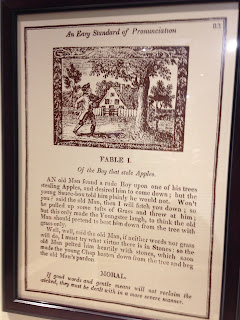
 Webster's library had some fascinating artifacts...


Beautiful gardens...


Plaques...


Statues...


Trains...


Like the Louvre and other museums, there was too much to see in just one day.


Wednesday, October 25, 2017

The Divine Game of the Hero

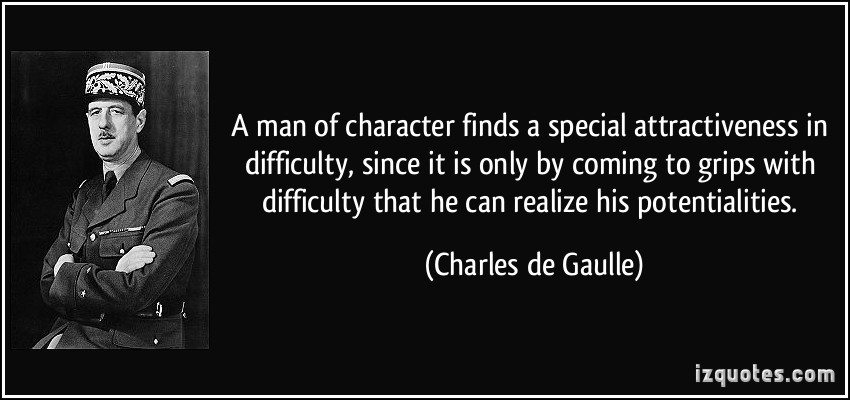
Charles-André-Joseph-Marie de Gaulle (22 November 1890 – 9 November 1970)
«L'homme de caractère confère à l'action la noblesse; sans lui morne tâche d'esclave, grâce à lui jeu divin du héros.» - Le Fil de l'épée (1932) de Charles de Gaulle

"The man of character bestows nobility upon action; without him it is the dreary task of the slave, thanks to him it is the divine game of the hero." - The Edge of the Sword (1932), Charles de Gaulle


Tuesday, October 10, 2017

To Become Like God


Andrew C. Skinner's To Become Like God is a life changing book.  It is rigorously researched and eloquently written, but more importantly, it communicates sublime truths in simple language.  To Become Like God expands the reader's vision of time and eternity, and it inspires the humble seeker of truth to reform his or her life in light of the ennobling doctrine of theosis, or in other words, deification.  "It is true intelligence," President John Taylor observed, "for a man to take a subject that is mysterious and great in itself and to unfold and simplify it so that a child can understand it." ("Discourse," Deseret News, Sept. 30, 1857, 238).  No subject is as mysterious and great as theosis, and in his book To Become Like God, Skinner unfolds and simplifies the subject in a marvelous way.

Skinner couches the Latter-day Saint doctrine of deification, or theosis, in its scriptural and historical context, and he shows Latter-day Saints the strength of their doctrinal position. (p. x)  "It is my hope," he writes in his preface, "that readers will see that belief in the possibility that human beings can become like God is not a deviation from original Christian beliefs." (p. x)  His explicit intention is both descriptive and apologetic, but he simultaneously achieves his goal "to elevate our perspective and instill in us a desire to rejoice again over the restoration of ancient doctrine, specifically the doctrine of deification or, as it is called in classical Christian theology, theosis - the teaching that mortals can become gods." (p. x) 

Skinner sets the stage for his masterful explanation of the doctrine of theosis with introductory chapters on the nature of God and Heavenly Father's perfect plan, because there is always the danger that emphasis on one particular doctrine of the Gospel may obscure the beauty of the whole.  Elder Neal A. Maxwell noted in his book A Time to Choose that:

"The doctrines of Jesus Christ by themselves are dangerous, as G.K. Chesterton observed. Any principle of the Gospel, isolated, spun off, and practiced in solitude, can go wild. The incomplete insight is not insight at all! Seeing the landscape of life illuminated briefly by lightning can be helpful, but we walk through a mortal minefield which requires the full steady light of the Gospel in order to survive. Just as the people of the Church need each other 'that all may be edified together,' the doctrines of the Church need each other."

Nevertheless, Skinner avoids the trap of isolating, spinning off, or practicing the doctrine of theosis in solitude by unfolding it within the context of the Plan of Salvation, which was prepared in Heavenly Father's perfect love, and actualized through the Atonement of the Savior Jesus Christ.  In this context, the ancient prophetic witnesses of the doctrine of theosis, along with the witness of Peter, the chief apostle, and the witnesses of the post-apostolic writers, Greek orthodoxy, the Protestant tradition, and the restored Gospel, become clearer.  By carefully establishing the connection between the doctrine of theosis and the undergirding and overarching truths of Heavenly Father's loving Plan of Salvation and the Atonement of the Savior Jesus Christ, Skinner inspires his readers to better understand and assimilate the truth concerning our divine potential.

In essence, Skinner sets out to answer a few basic questions: What does it mean to be a son or a daughter of God?  What does it mean to be a joint-heir with Jesus Christ?  What does it mean to become a possessor of all that the Father has?  What did ancient Christians believe about the ultimate purpose of our creation?  Do any other Christians hold similar views today? (dust jacket)  The simple answer to these last questions is that far from being a heresy, as some Christians suppose, the doctrine of theosis is one of the oldest and most fundamental teachings of Christianity.  Skinner draws from the writings of both ancient and modern Christians to demonstrate that the doctrine of deification was partially lost, and then fully restored through the instrumentality of the Prophet Joseph Smith.

Skinner's opening chapters are rich with true doctrine, doctrinal statements from the scriptures and latter-day prophets and apostles, and illuminating personal insights.  He unpacks the statement attributed to the early Church Father Athanasius about the role of Jesus Christ: "God became man, so that man might become God." (p. 4)  In the words of the contemporary Greek Orthodox theologian Christoforos Stavropoulos theosis means that "we are each destined to become a god; to be like God Himself, to be united with Him." (p. 8)  After shedding light on the meaning of theosis, Skinner touches on the nature of God, His character and attributes, particularly His perfect love.  Regarding God's Glory and Intelligence, he cites Elder Maxwell: "I testify that [God] is utterly incomparable in what He is, what He knows, what He has accomplished, and what He has experienced.... In intelligence and performance, He far surpasses the individual and composite capacities and achievements of all who have lived, live now, and will yet live!" (p. 19)  But Skinner notes that "one attribute of God seems to undergird and overarch all the rest: God is love (1 John 4:8)," or as is taught in Lectures on Faith: "lastly, but not less important to the exercise of faith in God, is the idea that he is love; for with all the other excellencies in his character, without this one to influence them, they could not have such powerful dominion over the minds of men; but when the idea is planted in the mind that he is love, who cannot see the just ground that men of every nation, kindred, and tongue, have to exercise faith in God so as to obtain eternal life?" (p. 21)  Skinner's chapter on the attributes of God is one that I will read over and over again, not only because it is true, but because it glows with the love of God.

Skinner's chapter on "The Father's Perfect Plan" is no less true, and no less inspiring.  What is the Father's plan, and why did He create it?  Skinner cites the Prophet Joseph Smith: "God himself [found] himself in the midst of spirits and glory, because he was greater... saw proper to institute laws, whereby the rest could have a privilege to advance like himself." (p. 27)  In other words, Heavenly Father wanted us to become like Him.  Heavenly Father's plan provides the privilege for His children to advance and to become like Him, and theosis is only possible through the Savior Jesus Christ whom God sent to execute the plan of salvation.  Again, The Prophet Joseph Smith explained:

"The great Jehovah contemplated the whole of the events connected with the earth, pertaining to the plan of salvation, before it rolled into existence, or ever ‘the morning stars sang together’ for joy; the past, the present, and the future were and are, with Him, one eternal ‘now;’ He knew of the fall of Adam, the iniquities of the antediluvians, of the depth of iniquity that would be connected with the human family, their weakness and strength, their power and glory, apostasies, their crimes, their righteousness and iniquity; He comprehended the fall of man, and his redemption; He knew the plan of salvation and pointed it out; He was acquainted with the situation of all nations and with their destiny; He ordered all things according to the council of His own will; He knows the situation of both the living and the dead, and has made ample provision for their redemption, according to their several circumstances, and the laws of the kingdom of God, whether in this world, or in the world to come." (p. 36)

Thus Jesus Christ came to do the will of His Father, or as the fourth-century Church Father Athanasius proclaimed "God became man, so that man might become God." (p. 38)

Skinner then shows that there were many ancient prophetic witnesses of theosis, the greatest of which is that of the Savior Jesus Christ.  He expounds upon many other Old and New Testament witnesses of theosis including Adam, Abraham, John the Beloved, and the Apostle Paul.  "It bears repeating," Skinner writes, "the doctrine of godhood is at the heart of what we aim for in the true Church of Jesus Christ.  Little wonder it is attacked, lampooned, downplayed, diminished, and ignored in our day." (p. 54)  The witness of Peter, the chief apostle, is particularly poignant with regards to the doctrine of theosis, or that which he called being "made partakers of the divine nature." (p. 59)  Peter received a powerful witness of the doctrine of theosis on the Mount of Transfiguration with Jesus and his fellow apostles James and John. (p. 67-68)

In addition to the witnesses of the Old and New Testament prophets and apostles, and to further establish the truth of the doctrine of theosis, Skinner draws from the witnesses of the post-apostolic writers, such as Athanasius, Justin Martyr, Irenaeus of Lyon, Clement of Alexandria, Hippolytus of Rome, Cyprian of Carthage, Polycarpus, Heraclitus, Basil, Gregory of Nazianzus, Gregory of Nyssa, Cyril of Alexandria, and deification in fifth century liturgy.  He consults the witnesses of Greek Orthodoxy, including Macarios of Philadelphia, Macarius of Egypt, John Chyrsostom, Maximus the Confessor, John of Damascus, Michael Psellus, and others of the Greek Orthodox and Roman Catholic tradition, including Bernard of Clairvaux and Nicholas of Cusa.  He gives voice to the witnesses of the Protestant tradition, including Martin Luther, John Calvin, John Wesley, Charles Wesley, and inspired protestant writers and poets.  He also highlights the witnesses of the restored Gospel, including Brigham Young, Parley P. Pratt, and many others.  Finally, Skinner echoes the witnesses of Joseph Smith and Lorenzo Snow.  In his King Follett discourse, Joseph Smith taught:

"Here, then, is eternal life, to know the only wise and true God. [D&C 132:24]  You have got to learn how to be Gods yourselves, and to be kings and priests to God, the same as all Gods have done; by going from one small degree to another, from grace to grace, from exaltation to exaltation, until you are able to sit in glory as doth those who sit enthroned in everlasting power; and I want you to know that God in the last days, while certain individuals are proclaiming his name, is not trifling with you or me." (p. 130)

Of course there are things that we don't know, and Skinner stops short of theological speculation.  In conclusion, he returns to his initial explanation of the nature and character of God in order to reemphasizes the truth that is most fundamental to the doctrine of theosis, namely, "God is love."  "The possibility that each of us may become like God," Skinner concludes, "should certainly humble us, but even more, it should thrill, inspire, and motivate us to strive to receive of God's fulness and his glory.  Such knowledge should transform the way we see our fellow human beings... Latter-day Saints, by doctrine and by practice, affirm that we are children of loving Parents who are anxious to have us return and live in their family unit, possessing what they possess.  The doctrine of deification is a manifestation of that love." (p. 142)

Andrew C. Skinner's book To Become Like God is a life changing book.  It scintillates with the light of truth and true intelligence.  More importantly, it radiates the love of God and the pure love of Christ.  To the many witnesses of our divine potential, or the doctrine of theosis, Skinner add his own witness: "For Latter-day Saints, life itself is entirely about becoming like God and living in families." (p. 142)  To Become Like God is a great addition to any Latter-day Saint Gospel library.  Moreover, it is a great addition to any Christian library.  Skinner provides convincing evidence that, far from being a deviation from original Christian beliefs, the belief in the possibility that human beings can become like God is central to the Christian faith. 

Thursday, September 21, 2017

In Great Deeds


(Credit to my brother Nathaniel Hancock for discovering and sharing this quotation) 

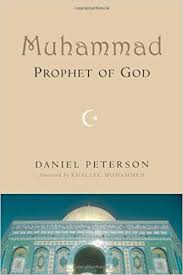
Muhammad: Prophet of God


Who was Muhammad?  What is the origin of the Qur'an?  What is Islam?  How did Muhammad found a world religion, an empire, and a civilization?  "Amid the swirl of current judgments regarding Muslims and their religion," writes Khaleel Mohammed in the forward to Muhammad: Prophet of God, "this book by Daniel Peterson offers a concise, objective, accessible biography of the first Muslim."  Parviz Morewedge praises Peterson's book as "the best scholarly text on the prophet Muhammad written by a Christian."  It is "a must-read, especially for non-Muslims who are interested in a solid, compassionate treatment of Muhammad's vision and accomplishments."  I couldn't agree more.

Peterson's book Muhammad: Prophet of God begins with an overture and a summary of the pre-Islamic period known as the "Arabian Jahiliyya" or the "Age of Ignorance," thus situating the prophet in his historical context.  Peterson's subsequent portrait of the birth and life of Muhammad is also rigorously researched and lucidly composed.  At the conclusion of his book, Peterson concedes that "Muhammad remains, today, a challenge for interpretation, a complex but commanding figure - much as he was for his own contemporaries." (p. 180)  Nevertheless, those who study Peterson's biography attentively will appreciate the sincerity, the character, and the charisma of the prophet Muhammad. Moreover, the charitable reader will gain a greater respect for the faith of the nearly two billion people who belong to the fastest growing religion, and the second largest religion in the world after Christianity.

Peterson introduces Muhammad as "a native of Mecca, a small oasis town dominated by an Arab tribe known as the Quraysh, who controlled its economy and politics and enjoyed immense religious prestige in connection with the local shrine known as the Ka'aba." (p. 15)  He was born into a "religiously complex" environment that was "suffused with a sense of spiritual anticipation." (p. 31) There are many disputed facts regarding the life of Muhammad, but Peterson asserts that he was born "into a religiously aristocratic Meccan family" that "had fallen on hard economic times and had perhaps lost out in certain squabbles and conflicts with other factions." (p. 34)  Muhammad was thus a "scion of a distinguished family, but poor - rather like a penniless aristocrat." (p. 37)  Peterson recounts with fairness some of the legends that surrounded the birth and childhood of the prophet.

For example, Muhammad is said to have been illiterate.  "The apologetic purpose of this," Peterson notes, "is immediately apparent: an illiterate Muhammad renders the miraculous nature of the Qur'an more dramatically evident." (p. 40)  Furthermore, "traditional Muslim accounts report that the Jews, too, were expecting the arrival of a prophet in Arabia - but that they also expected him, naturally enough, to come through a Jewish lineage." (p. 43)  Muhammad was a trustworthy young man who attracted the attention of the beautiful, older and wealthy daughter of Khuwaylid named Khadija. Muhammad married Khadija who gave him a wedding gift of a young slave boy named Zayd.  They had six children, four daughters and two sons, the latter of whom died very young.  Muhammad's role as the future prophet and uniter of the Arabs was foreshadowed by his replacement of the sacred stone and the reconstruction of the Ka'ba. (p. 48)

Peterson recounts that Muhammad was acutely aware of the "flaws and injustices of Mecca's stratified society." (p. 49) Some time after he began the "practice of withdrawing to a cave on Mount Hira" to meditate, "sometimes for several days and nights in a row," and "at some point near his fortieth year, Muhammad began to experience 'true visions,' which he said came to him while he was sleeping." (p. 50)  Peterson's account of Muhammad's early revelations is worth reading in its entirety, but in summary, Muhammad experienced a theophany.  Only later was the angel Gabriel identified as the vehicle of the revelation to "the messenger of God." (p. 52-53)    

Muhammad himself insisted that he was not an innovator but a messenger.  He "saw himself as getting behind the divisions of Judaism and Christianity, back to the original muslim or 'submitter,' Abraham."  With some initial trepidation, and with encouragement from another revelation, Muhammad "began to speak to his closest kind of his revelations and of his experience with the angelic messenger." (p. 63)  Like many prior and subsequent prophets, Muhammad was rejected by most of his fellow citizens.  Peterson describes this rejection: "The wealthy and influential citizens of Mecca largely held back form the new religion.  The ruling elite were too comfortable, too satisfied with the status quo, to feel any strong spur to change." (p. 65)  Conflict with the Quraysh led to the Hijra, or the migration of the prophet and his followers from Mecca to Yathrib, later called Medina. Soon after this exodus, Muhammad experienced the mir'aj or "Night Journey."  For those who wonder why Muslims pray five time per day, I recommend this chapter on The Hijra

The move from Mecca to Medina transformed Muhammad from a mere messenger into "a prophet-statesman, the founder of a political order and eventually of an empire that would change the history of the world." (p. 91)  Muhammad and his followers faced much strife with the Meccans, the Quraysh, and many others, but in what Muslims acknowledge as miraculous ways, they prevailed over their enemies.  Eventually, Muhammad and the other muslims returned to Mecca and regained control of the Ka'ba.  Muhammad restored monotheism and the worship of Allah, and abolished idolatry.  Peterson shows that Muhammad was merciful, "quite contrary to the image by which he has been stigmatized in the West, of bloodthirstiness and cruelty." (p. 148)  Peterson provides numerous examples of the prophet's clemency and noble character.  He was a man who believed and taught that the greater jihad was not war, but "the struggle with one's own soul." (p. 151)  Muhammad was gracious to his former enemies and showed a great deal of tolerance toward other "peoples of the Book." (p. 155)  

There is much more to be savored in Peterson's excellent book Muhammad: Prophet of God.  Read it as soon as you can, because Dr. Peterson's new book will also be worth reading. 

Saturday, September 2, 2017

Joseph Smith's Last Dream


I'm not sure how this story has eluded me until now.  In any case, I love it.  Praise to the man.

Saturday, August 12, 2017

Every Argument is an Apology


As soon as I finished reading Perspectives on Mormon Theology: Apologetics, I was prepared to write an unapologetic apology for apologetics in response.  However, I decided to browse the internet first, just in case someone had already written such an article.  As luck would have it, Daniel Peterson wrote "An Unapologetic Apology for Apologetics" about seven years ago.  This serendipitous discovery reminded me of Abraham Lincoln's astute observation: "I feel the need of reading.  It is a loss to a man not to have grown up among books... books [or in this case articles] serve to show a man that those original thoughts of his aren’t very new, after all."

I suppose that I could write an unapologetic apology for Peterson's unapologetic apology for apologetics, but there are at least a few chapters in Perspectives on Mormon Theology: Apologetics that merit an apology as well.  These chapters include Daniel Peterson's "A Brief Defense of Apologetics," Neal Rappleye's "Boundary Maintenance that Pushes the Boundaries: Scriptural and Theological Insights from Apologetics," Michael R. Ash's "I Think, Therefore I Defend," and Ralph C. Hancock's "Mormon Apologetics and Mormon Studies: Truth, History, and Love."  Juliann Reynolds' "The Role of Women in Apologetics" and Fiona Givens' "'The Perfect Union of Man and Woman': Reclamation and Collaboration in Joseph Smith's Theology Making" are also praiseworthy.

Aside from the six chapters mentioned above, each of the other nine chapters contains material that is in one way or another antagonistic toward, or critical of, old fashioned Mormon apologetics.  (For those who might be interested, Mr. So-and-So's review of Perspectives on Mormon Theology: Apologetics presents a viewpoint that is somewhat more sympathetic to the arguments advanced in these chapters).  However, in order to understand the reasoning behind the arguments for and against FARMS style Mormon apologetics, it is necessary to grasp what is meant by "Mormon apologetics." Furthermore, in order to understand the meaning of "Mormon apologetics," it behooves us to appreciate what is meant by the word "apologetics."

In the introduction to his unapologetic apology for apologetics, Peterson traces the etymology of the word "apologetics" to its roots, namely the Greek word απολογία, meaning"speaking in defense." Throughout his apology, Peterson employs the word "apologetics" in relation to attempts to prove or defend religious claims, but he is careful to note that "every argument defending any position, even a criticism of Latter-day Saint apologetics, is an apology."  This last assertion bears repeating: "every argument defending any position... is an apology."

Much of the confusion surrounding Mormon apologetics appears to be directly attributable to a muddled understanding of the apologetic tradition and a hazy comprehension of the definition of the word "apologetics." Perhaps some ancient Greeks were incensed by Plato's Apology, or defense, of Socrates, but at least they would have understood that arguments against Socrates or his apologists would also require a defense, or an apology.  It is not a coincidence that students today study Plato's Apology and Xenophon's Apology and not the apologies of those who condemned Socrates.  With the exception of Aristophanes's The Cloudsapologies contra Socrates are rather hard to come by. Mormon apologetics, like Christian apologetics, has also withstood the test of time.  In 1954, Hugh Nibley delivered a series of weekly lectures called "Time Vindicates the Prophets."  Were he alive today, I suspect that Nibley would agree that time vindicates Mormon apologetics as well.  Simply put, Mormon apologetics withstands the test of time because the truth claims that Mormon apologists defend are true.

In both of his articles, Peterson highlights several of major philosophers and writers in the venerable tradition of apologetics, including a few notable Mormon apologists.  Objections to the writings of any one of the major figures in the history of apologetics would require a sturdy apologetics of its own.  Even a rebuttal to C.S. Lewis's oft quoted apology for apologetics would require a thorough defense, or an apology:

"To be ignorant and simple now - not to be able to meet the enemies on their own ground - would be to throw down our weapons, and betray our uneducated brethren who have no defense but us against intellectual attacks of the heathen.

"Good philosophy must exist, if for no other reason, because bad philosophy needs to be answered. The cool intellect must work not only against cool intellect on the other side, but against muddy heathen mysticisms which deny intellect altogether.  Most of all, perhaps, we need intimate knowledge of the past. The learned life is then, for some, a duty.'"

Like good philosophy, good apologetics, including Lewis's apology and Peterson's more recent apology, is anchored in a sound understanding of the past.  It is rooted in good scholarship, properly understood.  Unfortunately, much of what passes for scholarship today is merely bad philosophy. Such scholarship flaunts its own perceived originality, but when set against the backdrop of intellectual history or the revealed word of God, such "scholarship" appears as so much nonsense.  C.S. Lewis explains:

"A man who has lived in many places is not likely to be deceived by the local errors of his native village; the scholar has lived in many times and is therefore in some degree immune from the great cataract of nonsense that pours from the press and the microphone of his own age."

Most of the articles in Perspectives on Mormon Theology: Apologetics are interesting and thought provoking, but many of them reflect the "local errors" of the "native village" of the modern academy. Although there are certainly many excellent scholars who do excellent work for excellent colleges and universities, it is not unheard of for institutions of higher learning to generate cataracts of nonsense or to stir up muddy heathen mysticism.  These defects in modern academia are sometimes the result of inordinate pressure to publish and to produce something new, when academics ought to invest more time and effort in rediscovering the wisdom of Lincoln's maxim: "Books serve to show a man that those original thoughts of his aren’t very new, after all."

Besides, as C.S. Lewis's demonstrates in his reflections on Christianity and literature, originality is overrated:

"The basis of all critical theory [is] the maxim that an author should never conceive himself as bringing into existence beauty or wisdom which did not exist before, but simply and solely as trying to embody in terms of his own art some reflection of eternal Beauty and Wisdom."

G.K Chesterton describes a similar matter succinctly:

"Dickens showed himself to be an original man by always accepting old and established topics. There is no clearer sign of the absence of originality among modern poets than their disposition to find new themes."

Apologetics is an old topic, as old as philosophy itself.  It is almost as old as Mormonism, which is as old as God Himself.  One might even date Mormon apologetics back to Adam, the Ancient of Days, and his wife Eve, both of whom blessed the name of God and made all things known to their sons and daughters.  (Moses 5:12)  As Lewis and Chesterton show, eternal things, or old and established topics, are always fresh and new, especially when juxtaposed against intellectual fads and academic fashions.  "Homer is new this morning," writes Charles Peguy, "and perhaps nothing is as old as today's newspaper."

As Peterson also notes in both of his articles, the English theologian and philosopher Austin Farrer clearly understood the value of apologetics:

"Though argument does not create conviction, lack of it destroys belief. What seems to be proved may not be embraced; but what no one shows the ability to defend is quickly abandoned.  Rational argument does not create belief, but it maintains a climate in which belief may flourish."

Peterson contends that Christians share an obligation to apologize, or "to give an answer to everyone who asks you to give the reason for the hope that is in you with meekness and fear." (1 Peter 3:15) Does this mean that every Mormon must engage in scholarly apologetics?  No.  Peterson explains:

"Not everybody has the capacity to do it, frankly, and most are not interested. But I think that every believer is obliged to use what he or she knows in order to defend the Church against its critics when the occasion arises, or to help struggling Saints - and that believers should be steadily improving their knowledge of Church doctrine, Mormon history, and the standard works so as to (among other things) meet obligations more effectively.  (If we are to do something, it seems to me obvious that we should try to do it well.)  Is every believer obligated to seek out opportunities to engage critics?  Again, no. Some may feel so inclined.  Most do not, will not, and should not." (p. 37)

In response to those who contend that Mormon apologetics is counterproductive or harmful to faith, Peterson points out that "even someone arguing that we ought not to do apologetics is, ironically, offering an apologetic for that position." (p. 39)  They are "arguing for their own vision of what discipleship ought to be." (p. 41)

In addition to the confusion caused by muddled understanding of the apologetic tradition and hazy comprehension of the word "apologetics," another source of the confusion surrounding Mormon apologetics is a misunderstanding of the relationship between faith and reason.  The age old debate
regarding reason and revelation is more relevant to Mormon apologetics than any contemporary progressivist, positivist, historicist, relativist, feminist, psychological or anthropological ideology. In Perspectives on Mormon Theology: Apologetics, those who defend Mormon apologetics demonstrate a solid grasp of the philosophical and scriptural foundations for understanding and articulating the relationship between reason and revelation.  In fact, it is likely that much of the the newfangled recalcitrance against Mormon apologetics arises from a misguided faith in unreflective, modern, academic affectation in the guise of rationalism.

In his chapter "Boundary Maintenance that Pushes the Boundaries: Scriptural and Theological Insights from Apologetics," Neal Rappleye correctly argues that "in many cases LDS apologetic approaches are actually pushing the boundaries of scriptural interpretation and theological understanding." (p. 62)  He provides several interesting examples in support of his thesis, and successfully demonstrates that "efforts to defend certain points of Latter-day Saint belief have often led to fresh perspectives on LDS scripture and theology." (p. 43)

In his chapter "I Think, Therefore I Defend," Michael Ash argues that Mormon apologists are not anti-intellectual, and that in fact the opposite is true.  He exposes the pretense of those who claim to operate on a plane of pure objectivity: "While it is certainly commendable and worthwhile to pursue assumption-free scholarship, unfortunately it's not something we humans are capable of doing very well." (p. 69)  "Study after study demonstrates," Ash writes, "that we are all apologists for our personal worldviews and that holding worldviews doesn't vitiate scholarly discourse." (p. 81) "Ironically," Ash concludes, "the very act of demarcating apologetics outside the scholarly arena is based on assumptions about the perceived boundaries between apologetics and scholarship and is, in itself, an exercise in apologetics." (p. 81)

In his chapter "Mormon Apologetics and Mormon Studies: Truth, History, and Love," Ralph C. Hancock reiterates what Peterson, Rappeleye, and Ash articulate so clearly: "So no one - or at least no one involved in the business of reasoning - can avoid being an apologist for something." (p. 91) With Socratic precision, Hancock sifts through a variety of specious arguments against Mormon apologetics.  He brings to light the problems inherent in the alternative frameworks of the academic disciplines, namely, that these disciplines "tend to hide their distinctive frames of reference behind a façade of neutral 'methodology.'" (p. 93) (see also, here)  One such façade is the false dichotomy of "Fact vs. Faith," which feeds into illusory claims of objectivity, or as Hancock explains: "It is impossible to approach the study of religion or of any fundamental dimension of human existence (politics, the family, literature, history) from a simply objective standpoint, since the object of research (humanity) cannot be divorced from the very being of the human researcher." (p. 95)  "Any pretense," Hancock observes, "of some inhuman, scientific objectivity can be nothing but a mask serving to evade Socrates's imperative to 'know thyself,' a device for hiding the scholar's point of view (even from herself) and to intimidate readers who might be tempted to contest this point of view." (p. 95)

Hancock also addresses the question of "tone," a complaint that some critics of Mormon apologetics attempt to levy against those with whom they disagree.  In essence, Hancock argues that objections to "tone" or exhortations to humility are distractions from clear reasoning and civil debate: "There is considerable risk of brandishing one's supposed humility in order to gain advantage over another in argument. 'More humble than thou' is not a promising posture in an intellectual discussion.  The classic warning about motes and beams ought to be kept in mind when the sublime virtue of humility becomes a stake in a debate." (p. 98)  In rigorous intellectual debates there is a place for bold correction or lively critique.  In short, Hancock concludes, "Some virtues are better taught by silent practice than by public brandishing." (p. 100)

Hancock's premise is "the fruitful complementarity, in principle, between the deepening of understanding and defense of Mormon beliefs with the exploration of ideas from other intellectual sources." (p. 100)  In other words, his premise is the age old fruitful complementarity between revelation and reason.  With this premise in mind, he continues his Socratic engagement with other interlocutors.  In the process he questions the cogency of his interlocutors' appeals to history or the viability of their adherence to contemporary conceptions of diversity, sexuality and love.

Juliann Reynolds and Fiona Givens present persuasive arguments on behalf of female Mormon apologists.  These excellent chapters reminded me of Elder D. Todd Christofferson's recent General Conference address "The Moral Force of Women."

Of the nine chapters in Perspectives on Mormon Theology: Apologetics that argue against traditional Mormon apologetics, Joseph Spencer's "Toward a New Vision of Apologetics" is the most coherent. He laments the "acrimony" between "conservatives" and "liberals" in debates concerning Mormon apologetics: "The latter accuse the former of a kind of intellectual backwardness, of using shoddy intellectual tools to protect the borders around an ill-defined orthodoxy in an unnecessarily reactionary way.  The former accuse the latter of a kind of intellectual shallowness, of following flighty but fashionable intellectual movements to erase the tried and true boundaries established by divinely called prophets." (p. 235)  Spencer correctly discerns that the primary question to consider is "What is apologetics?"  However, Spencer isn't just interested in what apologetics is, but in what apologetics ought to be.  In other words, his chapter is an apology for his idea of what Mormon apologetics ought to be.  To make his case, Spencer hones in on the relationship between reason and revelation, but he also falls prey to the false dichotomy that separates heart from mind.

Mormon apologetics, like the truth claims it defends, will outlast its critics.  Nevertheless, LDS scholars would do well to remember Elder Maxwell's counsel: "The LDS scholar has his citizenship in the Kingdom, but carries his passport into the professional world—not the other way around."  

Sunday, July 30, 2017

If

Rudyard Kipling

If


by Rudyard Kipling

If you can keep your head when all about you
Are losing theirs and blaming it on you,
If you can trust yourself when all men doubt you,
But make allowance for their doubting too;
If you can wait and not be tired by waiting,
Or being lied about, don’t deal in lies,
Or being hated, don’t give way to hating,
And yet don’t look too good, nor talk too wise:

If you can dream—and not make dreams your master;
If you can think—and not make thoughts your aim;
If you can meet with Triumph and Disaster
And treat those two impostors just the same;
If you can bear to hear the truth you’ve spoken
Twisted by knaves to make a trap for fools,
Or watch the things you gave your life to, broken,
And stoop and build ’em up with worn-out tools:

If you can make one heap of all your winnings
And risk it on one turn of pitch-and-toss,
And lose, and start again at your beginnings
And never breathe a word about your loss;
If you can force your heart and nerve and sinew
To serve your turn long after they are gone,
And so hold on when there is nothing in you
Except the Will which says to them: ‘Hold on!’

If you can talk with crowds and keep your virtue,
Or walk with Kings—nor lose the common touch,
If neither foes nor loving friends can hurt you,
If all men count with you, but none too much;
If you can fill the unforgiving minute
With sixty seconds’ worth of distance run,
Yours is the Earth and everything that’s in it,
And—which is more—you’ll be a Man, my son!

Wednesday, June 28, 2017

Which Loved Best?


“I love you, Mother,” said little [John];
Then, forgetting his work, his cap went on,
And he was off to the garden swing,
Leaving her the water and wood to bring.

“I love you, Mother,” said rosy Nell—
“I love you better than tongue can tell”;
Then she teased and pouted full half the day,
Till her mother rejoiced when she went to play.

“I love you, Mother,” said little Fan;
“Today I’ll help you all I can;
How glad I am that school doesn’t keep!”
So she rocked the babe till it fell asleep.

Then, stepping softly, she fetched the broom,
And swept the floor and tidied the room;
Busy and happy all day was she,
Helpful and happy as child could be.

“I love you, Mother,” again they said,
Three little children going to bed;
How do you think that Mother guessed
Which of them really loved her best?

- Joy Allison (a cute video)

A Bell Is No Bell Till You Ring It


A bell is no bell till you ring it
A song is no song till you sing it
And love in your heart wasn't put there to stay
Love isn't love til you give it away


(song)

Seize Upon Truth

Isaac Watts

Seize upon truth where'er 'tis found, 
Among your friends, among your foes, 
On Christian or on heathen ground — The flower's divine where'er it grows.
Neglect the prickle and assume the rose. 

Friday, May 19, 2017

My Only Hope and Confidence

The Prophet Joseph Smith
"My only hope and confidence is in that God who gave me being, in whom there is all power, who now is present before me, and my heart is naked before his eyes continually.  He is my comforter, and he forsaketh me not.

I know in whom I trust; I stand upon the rock; the floods cannot, no, they shall not, overthrow me."

- The Prophet Joseph Smith